Personality of the Month:
William Blake
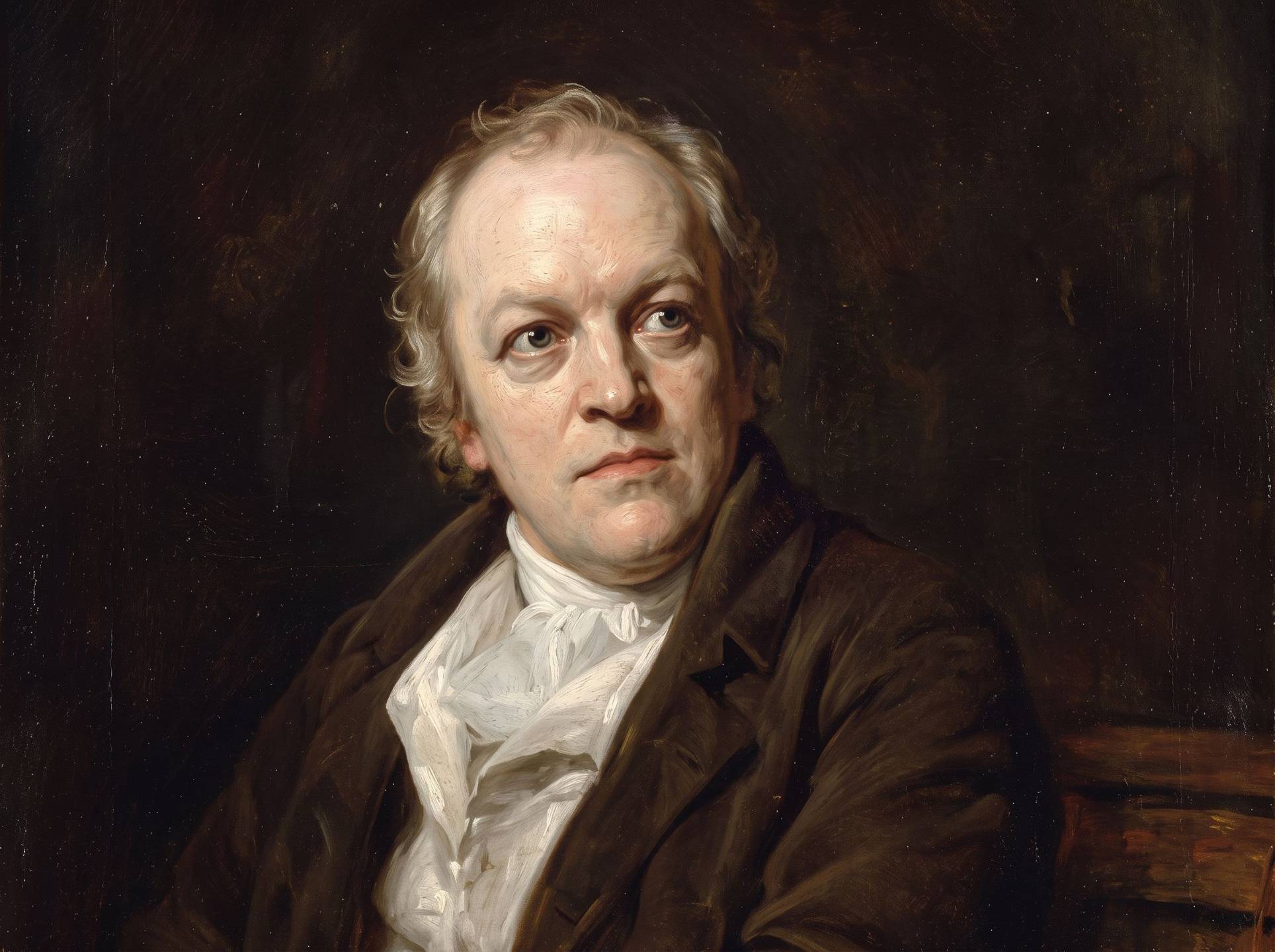
1757–1827
William Blake was born in London in 1757 and died there in 1827, having spent almost his entire life within a few miles of his birthplace, having sold almost nothing during his lifetime, and having been regarded by the majority of his contemporaries — to the extent that he was regarded at all — as an eccentric at best and a lunatic at worst. He is now understood as one of the most original and most significant figures in the history of English poetry, visual art, and esoteric philosophy.
He was, from childhood, a visionary in the strict sense: a person to whom visionary experience was not metaphor but perception. He described seeing a tree full of angels at Peckham Rye at the age of four. He described conversations with departed spirits throughout his life. He did not experience these as hallucinations to be managed, but as dimensions of reality to be engaged and reported. His enormous mythological poems — Jerusalem, Milton, The Four Zoas — are attempts to map a cosmology of the interior, a visionary geography of the human psyche in its fallen and redeemed states, drawn from the Bible, from Neoplatonism, from Swedenborg, from Gnostic traditions, and from the unmediated force of his own inner experience.
What connects Blake to the themes at the heart of this community is his root conviction — stated in dozens of forms across his entire body of work — that the imagination is not a faculty of fantasy but the organ of divine perception. For Blake, to imagine truly is to see as God sees: to perceive the eternal within the temporal, the infinite within the finite, the divine within the human. His famous line — "If the doors of perception were cleansed every thing would appear to man as it is, Infinite" — is not a romantic metaphor. It is a precise metaphysical statement about the nature of reality and the condition of the fallen, contracted human awareness that cannot see it.
This maps, with striking precision, onto the Sufi understanding of the qalb — the heart as the organ of divine perception — and onto Ibn Arabi's understanding of the Khyal, the creative imagination, as the faculty by which the divine self-disclosure (tajalli) is perceived. It maps onto Coomaraswamy's account of the artist as the vessel through whom a metaphysical truth seeks its appropriate visible form. It maps onto Plotinus's account of the Intellect (Nous) as the realm in which the divine forms are directly perceived, not abstractly known. Blake arrived at all of this not through systematic study of these traditions — though he read widely — but through direct experience. And this, too, is significant: it suggests that the interior territory these traditions are mapping is genuinely available to perception, not merely available to scholarship.
His Songs of Innocence and Experience — the poems most commonly encountered in school curricula — are the accessible surface of a vast and complex visionary architecture. The Prophetic Books, though demanding, reward patient engagement. And his visual work — the illuminated books he engraved, printed, and hand-coloured himself — must be encountered as the integration of word and image that he intended: neither element complete without the other.
For those who wish to explore:
- The Complete Poetry and Prose of William Blake, edited by David V. Erdman — the standard scholarly edition
- Blake: Prophet Against Empire by David V. Erdman — the essential historical and political contextualisation
- The Marriage of Heaven and Hell — the best entry point into his mature visionary thought
- Kathleen Raine, Blake and Tradition — situates Blake within the Neoplatonic and Hermetic streams to which he belongs; Raine is the finest guide to Blake's esoteric sources
Blake died singing. Those present at his death reported that his final hours were filled with a joy and radiance that astonished everyone in the room. He had spent his entire life insisting that death was not what the material world imagined it to be. In the moment of its arrival, he appears to have been proven right — at least to his own satisfaction.
"I give you the end of a golden string, Only wind it into a ball: It will lead you in at Heaven's gate Built in Jerusalem's wall."
With love and reverence,
SY