Personality of the Month:
Simone Weil
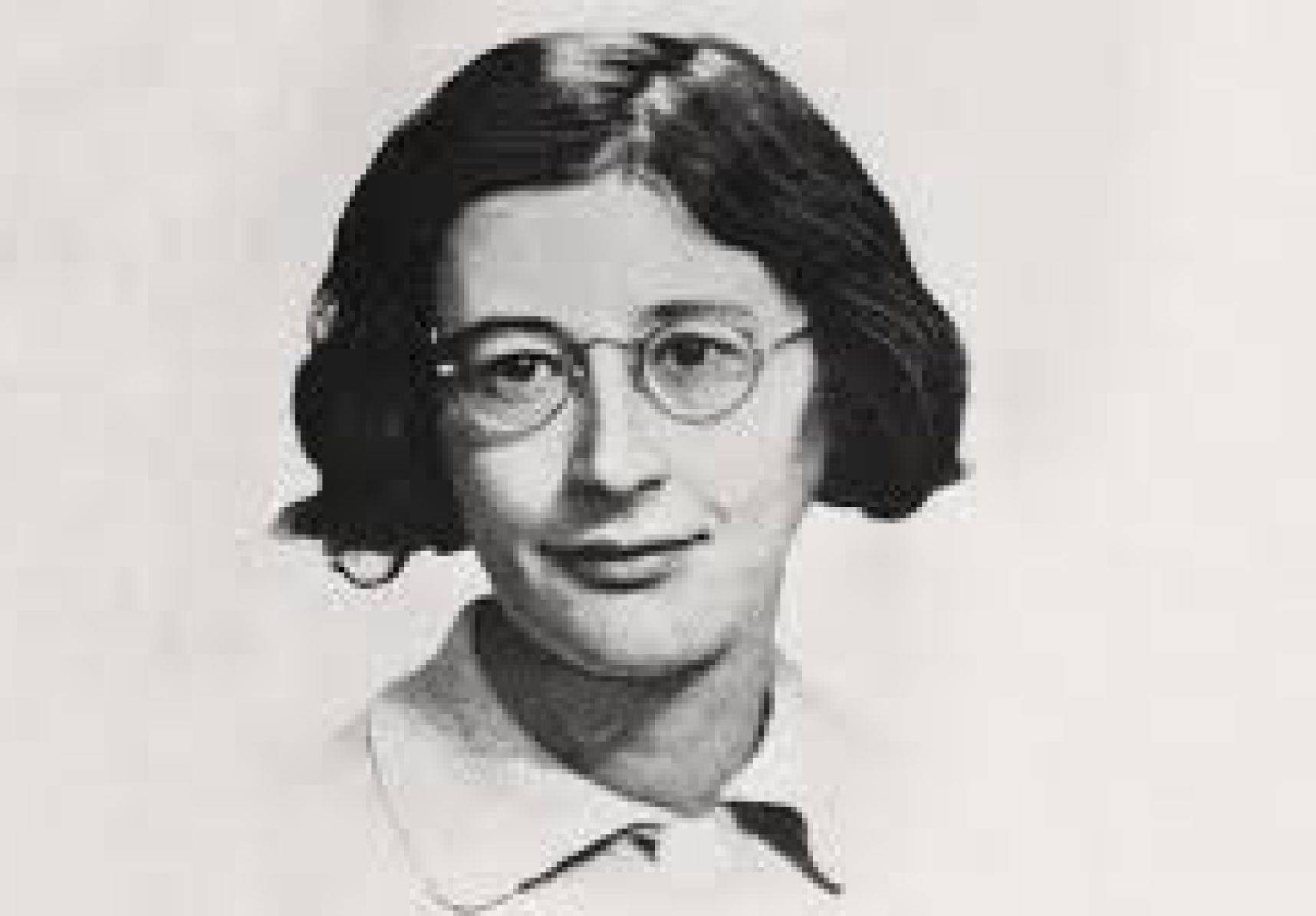
1909–1943
Simone Weil was born in Paris in 1909 into a secular Jewish family of considerable intellectual distinction. She died in a sanatorium in Ashford, Kent, in August 1943, having, by most accounts, weakened herself beyond recovery through her refusal to eat more than the wartime rations of those suffering under Nazi occupation in France. She was thirty-four years old. She had never published a book in her lifetime. She left behind a body of notebooks, letters, and essays of such compressed intensity that Albert Camus — who edited her first posthumous publication — described her as the only great spirit of our time.
She was, simultaneously, a philosopher trained in the rigorous French academic tradition, a labour activist who worked in factories in order to understand the condition of working people from the inside, a student of Greek philosophy who read Plato in the original, a passionate student of the Bhagavad Gita and of the Upanishads, and a Christian mystic who experienced — against all her intellectual expectations — a direct encounter with Christ during a recitation of George Herbert's poem Love (III) at the abbey of Solesmes.
She never converted formally. She refused baptism until the very end of her life, and it is unclear whether she received it. She could not bring herself to enter an institution that had, in her view, used the word anathema — the exclusion of the other — and thereby compromised the universality of love that she understood as the essence of the Gospel. This is not a comfortable position for orthodox Christians. It was not a comfortable position for Weil herself. She did not seek comfort. She sought truth.
Her central concept is attention — a word she uses with metaphysical precision. Attention, for Weil, is the capacity to be fully present to what is before us, without the self's habitual tendency to impose its own needs and interpretations upon it. It is, in her understanding, the root of all genuine love, all genuine knowledge, and all genuine art. The ability to attend — truly attend, without appropriating — is extraordinarily rare and extraordinarily difficult. And it is, she argues, the core of what it means to pray.
This resonates with extraordinary directness with the Sufi understanding of muraqaba — watchful attention, the meditative practice of sustained inner awareness — and with the Platonic understanding of theoria — contemplation as the highest activity of the intellect. It resonates with Eckhart's Abgeschiedenheit — the detachment that empties the soul so that it can receive. Different vocabularies, one discipline.
Her concept of affliction — malheur in French — is perhaps her most original and most unsettling contribution to spiritual thought. Affliction, for Weil, is not simply suffering. It is suffering so extreme that it attacks the soul's very sense of its own worth, crushing it into something that can no longer even cry out. And yet it is precisely in this extremity — in the moment when all self-assertion has been stripped away — that the possibility of contact with the divine becomes most available. This is not masochism. It is a rigorous account of the mechanism by which the ego, which ordinarily screens the soul from reality, is dissolved.
The parallel with the Sufi concept of fana — annihilation — is not incidental. Weil arrived at this understanding independently, through a combination of direct experience, philosophical rigour, and engagement with Plato's account of the soul in the Phaedo and the Republic. That she reached the same interior territory by a different route is, once again, evidence of the Perennial insight: the truth of the inner path is not culturally contingent. It surfaces wherever the conditions — sincerity, rigour, and a willingness to follow the truth wherever it leads — are present.
For those who wish to encounter her:
- Waiting for God, translated by Emma Crawford — the most accessible entry point
- Gravity and Grace, edited by Gustave Thibon — a distillation of her notebooks
- The Need for Roots — her most political work, commissioned by de Gaulle's Free French and arguably still the most searching analysis of what is missing in modern European civilisation
- Francine du Plessix Gray, Simone Weil — a fine biographical introduction
Simone Weil reminds us that spiritual life is not a comfort. It is, if taken seriously, the most demanding possible orientation of a human life. She also reminds us that the demand is worth it — that the attention she cultivated opened her, at unexpected moments, to something that she could only describe as love so absolute that it left her shaking.
She did not ask for it. She had not expected it. It came.
With love and reverence,
SY