Personality of the Month:
Muhyiddin Ibn Arabi
1165–1240
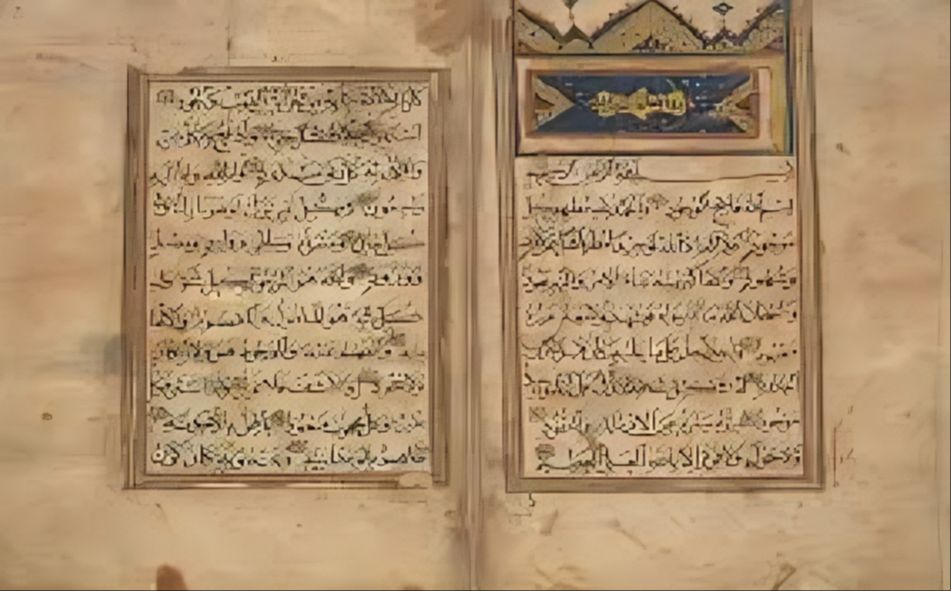
Muhyiddin Ibn Arabi was born in Murcia, in Muslim Andalusia, in an age when Islamic civilisation stood at one of its great peaks of intellectual and spiritual flowering. By the time of his death in Damascus, he had produced a body of work so vast, so intricate, and so daring in its metaphysical reach that scholars have spent eight centuries attempting to map its full dimensions. His two most celebrated works — al-Futuhat al-Makkiyya (The Meccan Illuminations) and Fusus al-Hikam (The Bezels of Wisdom) — remain among the most studied and debated texts in the entire history of Islamic thought.
What makes Ibn Arabi irreducible is his doctrine of Wahdat al-Wujud — the Unity of Being. This is not pantheism, as his critics have sometimes charged. It is something far more precise and far more radical: the recognition that there is, ultimately, only one Reality, and that all apparent multiplicity — all the forms, names, and distinctions through which we navigate existence — are the self-disclosure of that single Reality to itself. In his vocabulary, this self-disclosure is called tajalli. The world, in this understanding, is not separate from God. It is the mirror in which the Divine contemplates its own infinite face.
This is metaphysics of the highest order. And it carries immediate consequences for how we understand beauty, art, and the act of listening.
If every form is a tajalli — a self-disclosure of the Real — then beauty is not merely aesthetic. It is ontological. To encounter genuine beauty is to encounter a trace of the Absolute. This is why the great art of the Islamic world — its geometry, its calligraphy, its music — was never understood as mere decoration. It was understood as a form of remembrance, a way of pointing the heart back toward its source.
Ibn Arabi understood the human being as the Insan al-Kamil — the Universal or Perfect Man — not as a claim about any individual's moral superiority, but as a metaphysical category. The human being is the being in whom all the divine names are gathered and reflected. We are, in his vision, the point at which the infinite meets the finite, the place where the Absolute knows itself most fully. This is a staggering responsibility. And it is one that Ibn Arabi believed was inseparable from knowledge — not the accumulation of information, but the realisation of what we already, at our deepest level, are.
His influence has been immeasurable — on Persian poetry (Rumi's thought is unthinkable without him), on Ottoman intellectual culture, on the later development of Shi'i philosophy in Iran, and, as we saw in last month's profile of Meister Eckhart, on the comparative study of mystical metaphysics across traditions. The convergences between Ibn Arabi and Eckhart — two near-contemporaries who almost certainly never encountered each other's work — remain one of the most astonishing facts in the history of human thought. Both arrived, by different routes, at the same interior landscape.
For those wishing to go deeper, I would recommend:
- The Bezels of Wisdom (Fusus al-Hikam), translated by R.W.J. Austin — the most accessible entry point into his thought
- The Sufi Path of Knowledge by William C. Chittick — the finest scholarly introduction in English
- Alone with the Alone by Henry Corbin — a profound meditation on Ibn Arabi's creative imagination as a spiritual faculty
- Toshihiko Izutsu, Sufism and Taoism — for those who wish to understand how Ibn Arabi's metaphysics speaks across traditions
Ibn Arabi reminds us that the path of knowledge and the path of love are not two paths. They are one. And that the deepest knowing is not achieved by the mind straining toward an object — but by the heart expanding until it contains everything.
With love and reverence,
Sami