
Personality of the Month:
Meister Eckhart
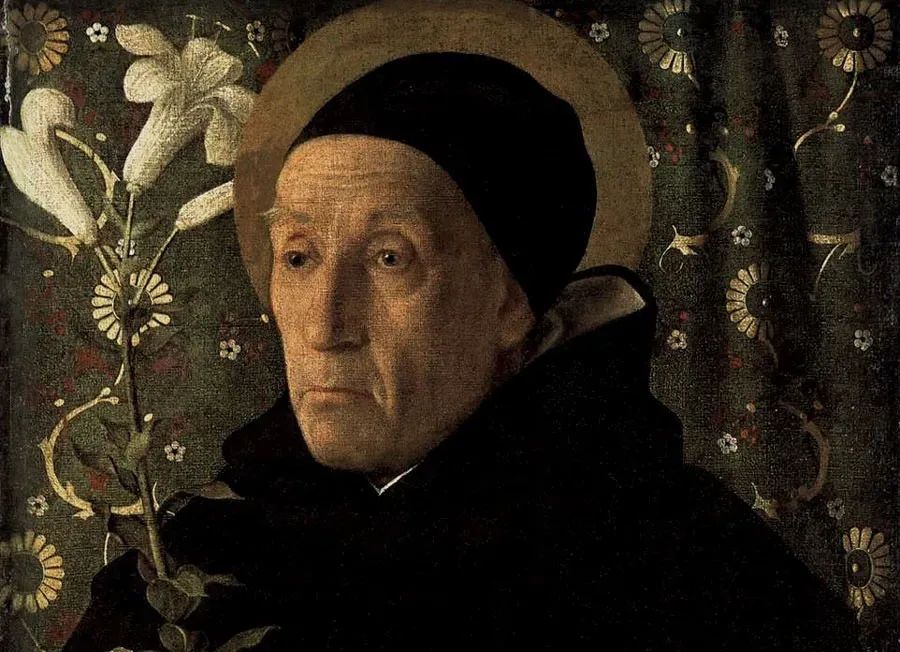
1260 - 1328
Meister Eckhart (circa 1260 – circa 1328) was a German Dominican friar, theologian, preacher, and one of the most profound mystics in the Western spiritual tradition. Living at the height of medieval scholasticism, Eckhart moved effortlessly between rigorous theological precision and the most daring expressions of mystical insight ever articulated in the Christian world.
What makes Eckhart truly extraordinary is the clarity and audacity with which he spoke about the inner life. He did not speak of God as a distant object of belief, but as an ever present Reality to be realised within the depths of the soul. His central themes revolve around detachment, inner poverty, and the breakthrough into what he called the Gotheit — a Reality beyond all names, forms, and concepts.
One of Eckhart's most striking teachings is his insistence that the highest spiritual realisation occurs not through external acts, but through radical inner emptiness. When the soul becomes empty of all attachments, even of its own ideas about God, it becomes capable of receiving the Divine fully. In his own uncompromising words, the soul must become so empty that God can act freely within it.
This radical detachment — Abgeschiedenheit in Eckhart's own Middle High German — is not mere passivity. It is an active stripping away of everything that is not essential. And here, the resonance with Sufism becomes unmistakeable. What Eckhart calls Abgeschiedenheit, the Sufi tradition calls fana — the annihilation of the self in the Divine. Both point to the same interior movement: the emptying of the ego so that something greater can pour in. For those who have sat with the music — with pieces like Nasimi or The Centre — and felt something wordless occurring in the listening, Eckhart offers a philosophical map for exactly that experience.
At the deepest level of his metaphysics, Eckhart speaks of the Grunt der Sele — the Ground of the Soul — a point so interior, so silent, that it exists beyond all duality, beyond even the distinction between the human and the Divine. This maps directly onto the Sufi understanding of the qalb, the heart as the seat of divine knowledge and the place where God is most intimately known. Different languages, different centuries, the same territory.
Perhaps the most striking parallel in the comparative mystical tradition is between Eckhart and Ibn Arabi (1165–1240), the great Andalusian Sufi metaphysician. They were near-contemporaries — Ibn Arabi died roughly two decades before Eckhart began preaching. The conceptual resonances are extraordinary and have been noted by serious comparative scholars, most notably Toshihiko Izutsu. Eckhart's Gotheit — the Godhead beyond God, the nameless Absolute that lies behind all divine names and attributes — maps with remarkable precision onto Ibn Arabi's concept of al-Ahadiyya, the pure Oneness that precedes even the names and qualities by which the Divine is known. Both men arrived at a vision of Reality so radical that it unsettled the religious establishments of their day.
This emphasis on inwardness, silence, and direct realisation places Eckhart firmly alongside the great metaphysical voices of the world, whether in Advaita Vedanta, Sufism, or Taoism. It is no coincidence that his work continues to be rediscovered by seekers across traditions who recognise the universality of his insights.
Eckhart's teachings were controversial in his own time. Near the end of his life, some of his propositions were examined by ecclesiastical authorities, largely because his language pushed far beyond conventional theological boundaries. Yet even his critics acknowledged his integrity, humility, and devotion. Today, he is widely regarded not as a heretic, but as one of the great masters of Christian mysticism.
One passage from his sermons, written in the Middle High German of his time, contains his entire metaphysics:
Daz ouge, da inne ich got sihe Daz ist daz selbe ouge, da inne mich got sihet Min ouge und gotes ouge daz ist ein ouge
"The eye through which I see God is the same eye through which God sees me. My eye and God's eye — that is one eye."
Sit with that. It is not poetry. It is a precise metaphysical statement. And it is one that any sincere student of Ibn Arabi, of Rumi, of Shankara, would immediately recognise as their own.
These very lines are ones I have carried with me for a long time. They found their way, in their original Middle High German, into my composition ONE — performed as part of the first edition of the When Paths Meet concert series, recorded live at Amsterdam's Royal Concertgebouw. That a Christian mystic of 13th century Germany should find himself in a seamless dialogue with the Arabic poetry of Abu al-Hasan al-Shushtari within a single composition — that, to me, is the whole point. Not ‘fusion’, but the recognition that these voices were always, at their root, speaking of the same in inner Reality.
For those wishing to explore his thought further, I would especially recommend:
- Meister Eckhart: Selected Writings — a strong starting point
- Die deutschen und lateinischen Werke — the critical scholarly edition of his complete German and Latin works, for those who wish to encounter him in the original
- Ananda Coomaraswamy, The Transformation of Nature in Art — Coomaraswamy draws explicit and illuminating parallels between Eckhart and the metaphysics of Meister Shankara and classical Indian thought. One of the most important comparative works in the Traditionalist canon
- Seyyed Hossein Nasr, Knowledge and the Sacred — Nasr's magisterial work on sacred knowledge situates the mystical intellect across traditions, including the Christian contemplative stream in which Eckhart stands
- Toshihiko Izutsu, Sufism and Taoism — while focused on Ibn Arabi and Lao Tzu, Izutsu's method of structural comparison provides the most rigorous available tool for understanding why Eckhart and Ibn Arabi are not merely similar, but metaphysically convergent
Meister Eckhart reminds us that true spiritual knowledge is not accumulated, but unveiled. That the deepest truths are not grasped by the mind, but realised in silence. And that the ultimate aim of the path is not to become something new, but to return to what we have always been at the deepest level of our being.
Meister Eckhart’s vision belongs to no single tradition. It belongs to that interior country that every genuine mystic — whatever their language, whatever their century — has quietly mapped. That country is the real subject of my music. And perhaps that is why, when the music reaches you in the right moment, something in you already knows the way.
With love and reverence,
SY