Personality of the Month:
Lalla
c. 1320–1392
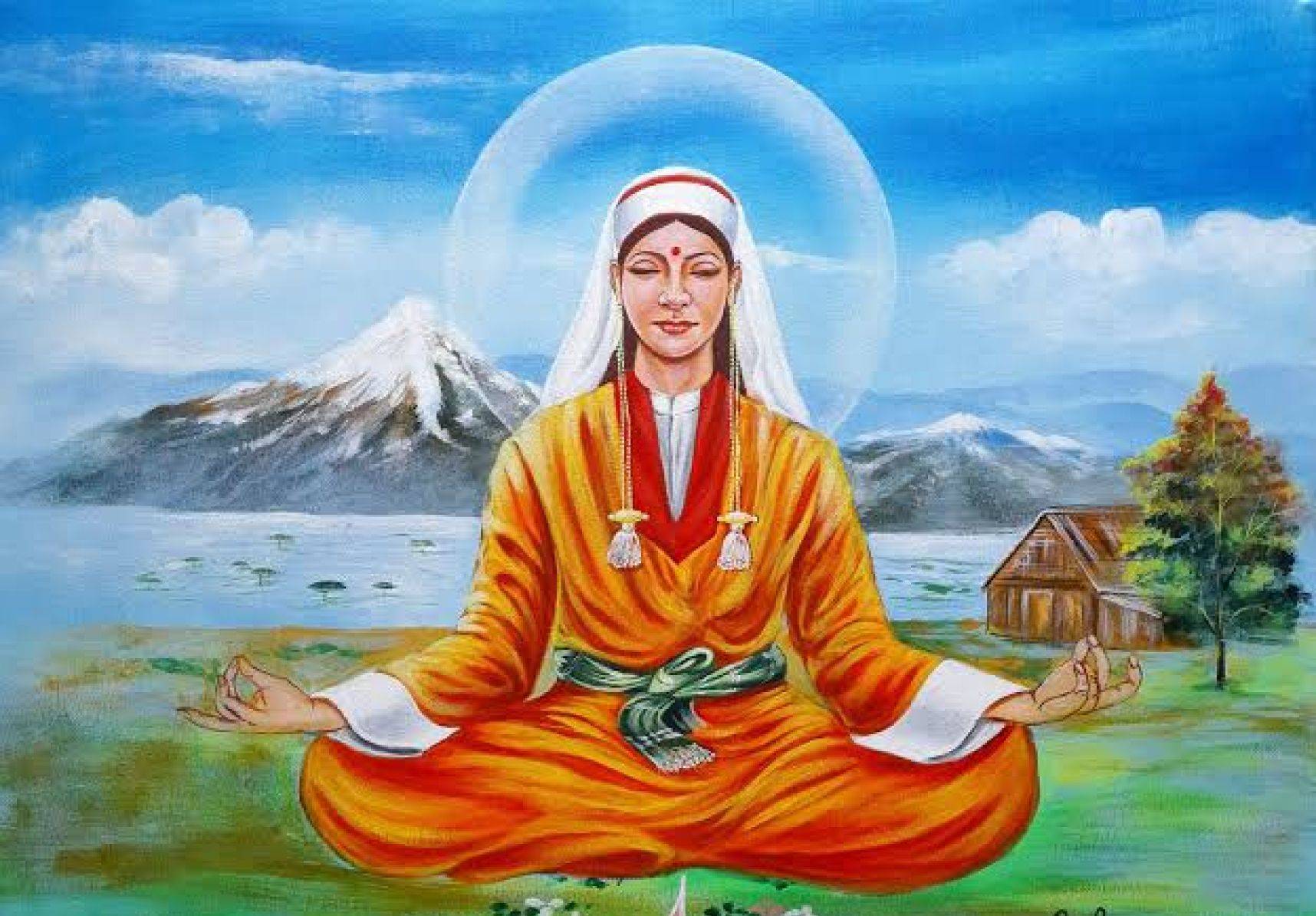
Lalla was born in Kashmir — most likely in the village of Pandrethan, near Srinagar — around 1320. She died around 1392. Almost everything else about her biography is disputed, legendary, or impossible to verify. What is not in dispute is the extraordinary body of verse — the vakhs, short, compressed lyric utterances in the Kashmiri language — that has been attributed to her, memorised, sung, and recited continuously in Kashmir for six and a half centuries, by Hindus and Muslims alike.
This in itself is remarkable. Kashmir in the 14th century was a space of extraordinary religious complexity, at the intersection of Shaivite Hindu traditions going back millennia and the newly arrived Sufi orders — particularly the Kubrawiyya and the followers of Mir Sayyid Ali Hamadani — who were beginning to transform the valley's religious landscape. Lalla lived through this encounter. And rather than taking sides, she dissolved the question of sides altogether.
Her vakhs are not philosophical treatises. They are detonations. Short, fierce, imagistically compressed verses that arrive like blows and leave a silence afterward. They speak of the Self — not the personal self, but the Self that Shaivite tradition calls Shiva and that Sufi tradition calls al-Haqq, the Real — as the only thing worth seeking, the only thing that is truly found, the only thing that was never, in fact, lost.
I searched for myself and found only God. I searched for God and found only myself.
[This is a paraphrase of the spirit of her vakhs, not a direct quote.]
This reciprocal dissolution — the self found to be God, God found to be the self — is structurally identical to Eckhart's Gotheit, to Ibn Arabi's Wahdat al-Wujud, to Shankara's Advaita. Different Kashmir, different century, different language, different tradition — the same interior recognition.
What distinguishes Lalla from many mystics is the radical embodied freedom her life expressed. The stories of her wandering naked through the mountains — which she herself references in her verses, speaking of having shed the garment of shame — are not mere biographical anecdote. They are a statement. The body, the social role, the garment of respectability and religious convention — these are among the coverings that the vakhs are calling us to shed, not in literal imitation, but in interior attitude. What remains when all coverings are removed is not nothing. It is everything.
She is claimed equally by Kashmiri Shaivites and by Sufi Muslims. Both communities have their own stories of her connection to the saints and sages of their respective traditions. The historical details of these connections cannot all be verified. But the phenomenon itself is significant: a woman whose spiritual authority was recognised across the sharpest religious boundary of her time and place. Like Rabia before her, Lalla achieved this not by argument or by institutional power, but by the unmistakable quality of her presence — and of her verse.
For those who wish to explore:
- I, Lalla: The Poems of Lal Ded, translated by Ranjit Hoskote — the finest literary translation in English, with a superb critical introduction
- The Ascent of Self by B.N. Parimoo — situates her within the context of Kashmiri Shaivism
- Annemarie Schimmel's writings on the meeting of Hindu and Muslim mysticism in the Indian subcontinent provide invaluable background
Lalla is a reminder that the boundaries we draw around traditions are, at the deepest level, administrative. The reality that all genuine mystics are pointing toward does not observe them. It flows through them — and, at certain extraordinary moments, through certain extraordinary human beings, it flows regardless of them entirely.
With love and reverence,
SY