My Composition ‘Nasimi’:
A Deeper Understanding
Since the release of my composition ‘Nasimi’, I have been heartened by the growing interest in the life and legacy of the great poet who inspired it. I feel it is the perfect moment to share more about the how and why of this work, speaking directly to those who have expressed a genuine desire to delve deeper into the origins of these verses and my decision to set them to music.
I composed ‘Nasimi’ in 2019 as one of nine works commissioned for the UNESCO World Heritage Congress in Baku, Azerbaijan. Each piece presented an essential part of Azerbaijani heritage to the international assembly. Since Imadaddin Nasimi is universally regarded as one of the greatest figures of Turkic literature, UNESCO had declared that the 600th anniversary of his birth in 1973 be celebrated worldwide, and 2019 was declared The Year of Nasimi in Azerbaijan in celebration of his 650th anniversary. I was therefore given specific lyrics from his poetry to use as part of one of my compositions.
Of the nine works I composed and performed for UNESCO, the one that became most popular was titled ‘Nasimi’.
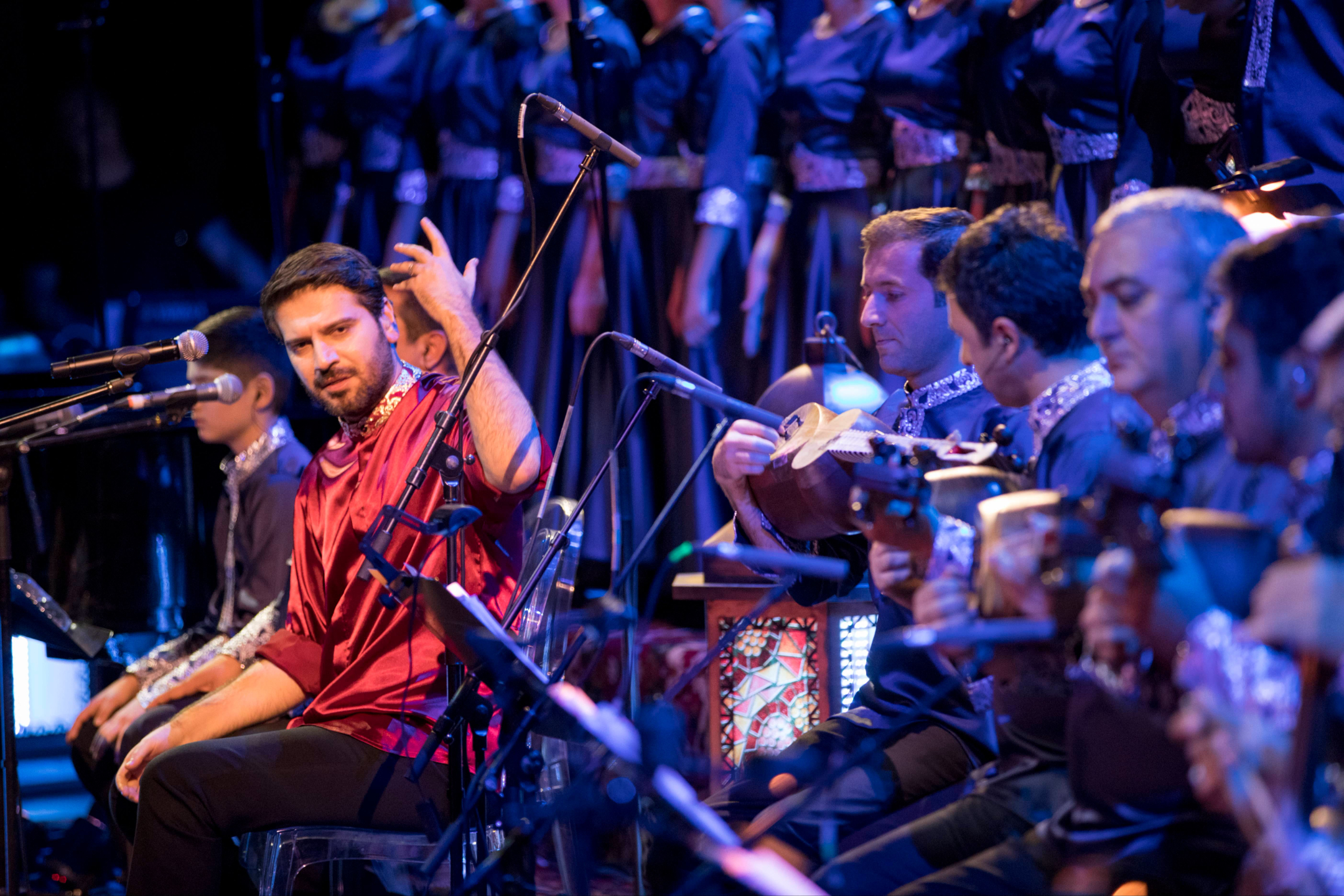
The music for ‘Nasimi’ was written in Shur mugham, one of the seven main modes in Azerbaijani music, and one that evokes a fiercely passionate state in its listeners. With high-energy percussion and beautifully performed mugham vocalisations, I sought to create a musical narrative that expressed the fire at the heart of Azerbaijani/Turkic musical heritage. To capture the complex modal systems of this region, I scored the instrumentation to highlight the range of their traditional instruments including the tar, kamancha, oud, kanun, unique percussions, and balaban. Simply put, I intended the music of ‘Nasimi’ to celebrate the living artistic language of the Turkic world and the people who embody it today.
I am, before anything else, a composer rooted in world music traditions. I do not choose lyrics to proselytise; I choose them for their literary value and the way they represent a pinnacle of a given language or culture. In the case of Nasimi, clearly his works hold a foundational place in the Turkic literary canon. He is revered across the Turkic world not only as a poet but as a spiritual luminary whose writings helped form the very soul of the language. Across West and Central Asia, he has been celebrated for over six centuries by poets, musicians, Sufi orders, scholars, and ordinary believers. A figure honoured for so long cannot be dismissed simply as “outside the tradition.”
My intention in my composition, ‘Nasimi’, was not to present theological arguments or defend any doctrinal positions, but rather to focus on this particular poem as giving voice to love, existence, and the complexities of human experience. It is well known that figures such as Nasimi, alongside others such as al-Hallaj and Bayazid Bastami, have been interpreted in different ways across Islamic history. Their language often belongs to a tradition of symbolic and ecstatic expression that has been both appreciated and debated. I do not seek to resolve these interpretations, but to present the work within an artistic framework that acknowledges its depth and complexity.
We must remember that for over a thousand years, Islamic civilisation has embraced nuance, metaphor, and layered meaning, especially in poetry. Among our greatest scholars and saints are those who understood that ecstatic or symbolic language is a hallmark of spiritual literature, not a threat to faith.
As for my own work, my way is the way of love, light, and inclusivity. Those who follow my music know that my role could be said to be that of a mediator bringing historical voices into the contemporary artistic space. If my music or artistic approach does not resonate with someone, they may simply choose not to listen.
My purpose has always been to celebrate the beauty of traditional art, culture, and heritage, with gratitude for the genius of my own tradition, whose contributions to humanity in love, wisdom, and beauty are immeasurable. I will continue to honour that tradition with devotion and reverence.
With love, always.
SY